Themes
newS
A new monograph and a new theme
August 12 2026: A new theme today, trailing the next monograph in the series, which continues the story of EDWARD THOMAS into the First World War.
Eleanor meets edward
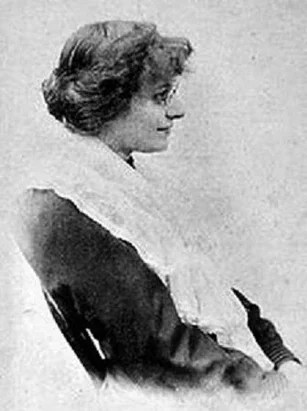
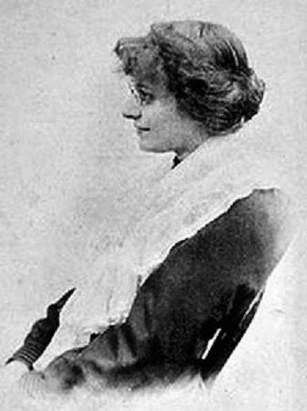
“One day towards the close of 1912, my brother Bertie said to me, “Edward Thomas is coming to town tomorrow and wants me and Godwin to have tea with him. He has asked if you and Rosalind would come too.”
Eleanor Farjeon – “Edward Thomas: The Last Four Years.” (1958)
“I introduced Edward Thomas to Godwin Baynes and his circle of Hampstead friends: Arnold and Clifford Bax, Joan and Bertie Farjeon and Bertie’s sister, Eleanor. Meeting these younger people was a liberation for Thomas.”
David Garnett – Great Friends (1980)
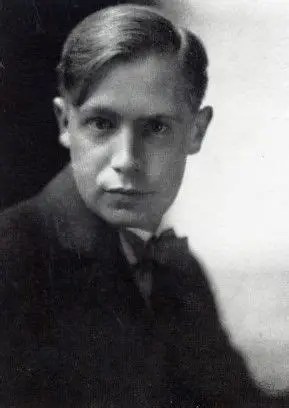
“I don’t remember anything that was said, but to look at and listen to Edward was enough; he had a higher degree of beauty of person, voice, and mind than I had ever known combined in anybody, or have known since.”
“These new friends welcomed him. Eleanor fell in love with him.”
Thomas had a very similar effect on Catherine Abercrombie, wife of the poet/critic Lascelles Abercrombie when she met him for the first time in April 1914.
“I think Edward was the most beautiful person I had ever seen. It was quite a shock on first meeting him, unless one had been warned. He suffered very much from recurring melancholy, which stamped itself on his face but only made his beauty more apparent.”
[Quoted by Sean Street, The Dymock Poets (1994) p. 82]
Catherine, unlike Eleanor, did not fall head over heels for Thomas. Instead she was rather hostile to begin with, because he had been critical of Abercrombie’s first attempt at publishing his own verse, “Mary and the Bramble” (1911).
Catherine Abercrombie, nee Gwatkin, 1881-1968
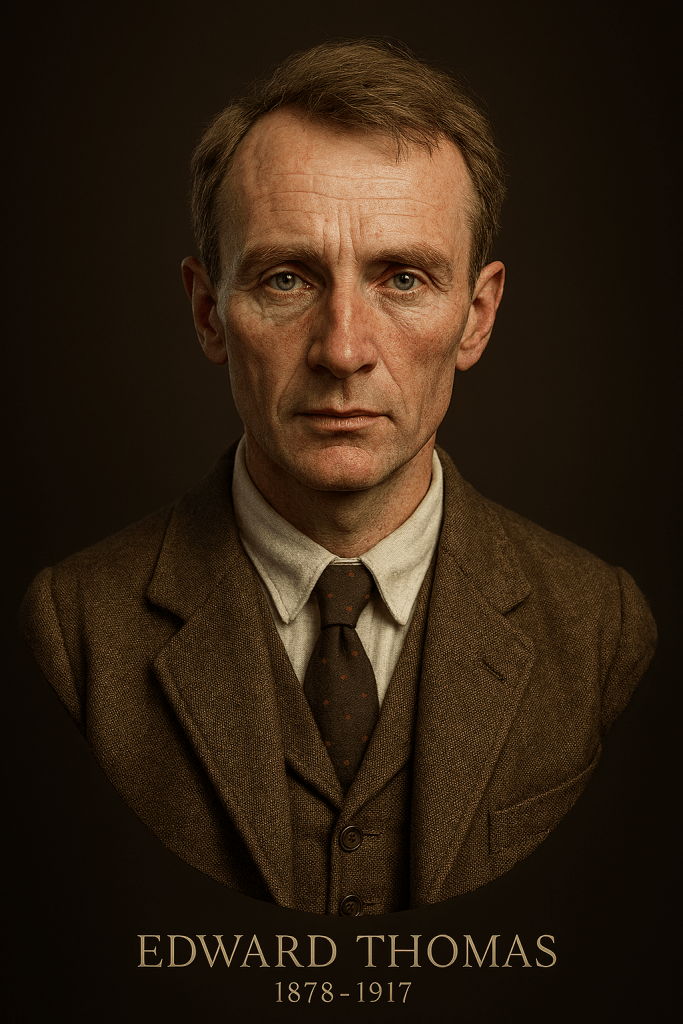
Edward Thomas
Themes developed in Monograph #1, MENTORING EDWARD THOMAS. Exploring his mentorship by JAMES ASHCROFT NOBLE (and others) and the writers young Thomas was introduced to or discovered for himself, notably ALEXANDER SMITH and RICHARD JEFFERIES.
Edward thomas, the early years
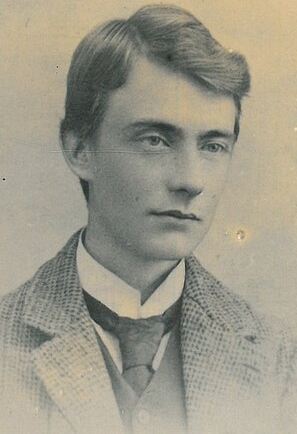
Edward Thomas was born in London but his background was Welsh. He was close to his paternal grandparents who lived in Swindon, Wiltshire, and Edward spent holidays there. He therefore walked the same hills and fields that Richard Jefferies wrote about in books like The Gamekeeper at Home and The Amateur Poacher – books the young Edward Thomas couldn’t get enough of. The connection with Jefferies seemed even stronger when Thomas discovered that as a young man Jefferies had also lived in London, in the same district young Thomas was now exploring. Jefferies had even written a book, Nature Near London, about the suburban landscape. Thomas’s own first book, The Woodland Life, published when he was only nineteen, dealt with the same subject, albeit in a very different style.
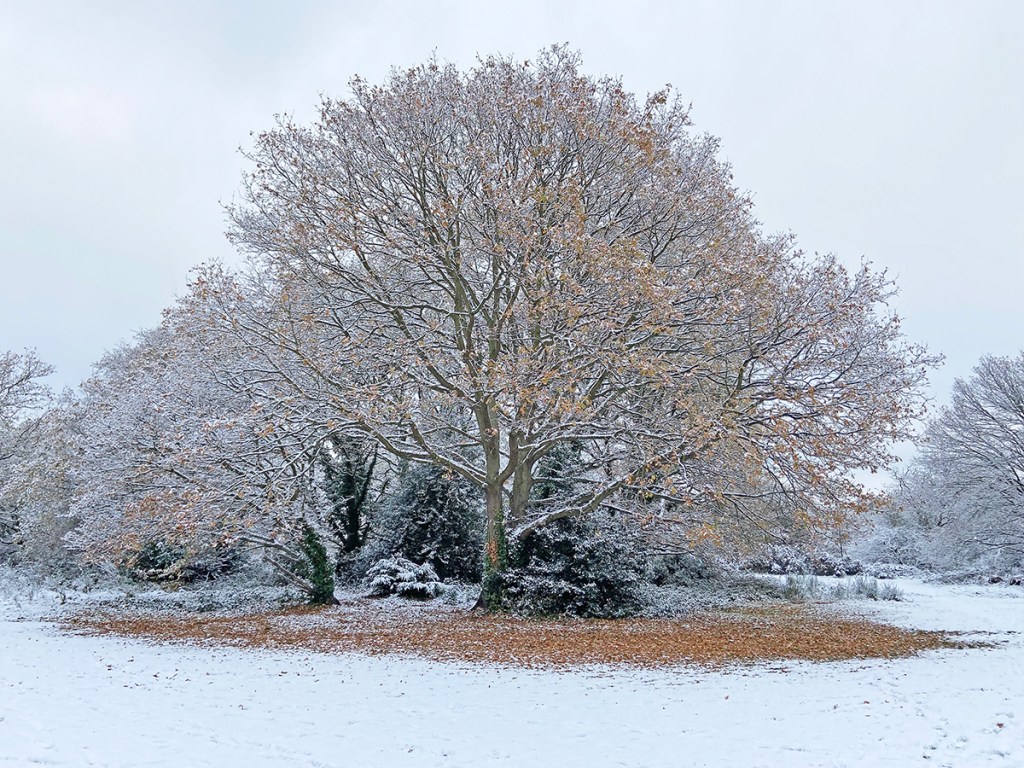
Edward Thomas: Winter woodland
Thomas’s debut book, A Woodland Walk (1897), included a nature journal kept by him over the months immediately preceding publication. This is the entry for December 28 1896:
“Wretched squatter’s dwelling in the midst of a bare joyless common – rude plank shed, patched with sacks, and hedged by a mound of sods with thorns at top, and birches sheltering the cote of the pigeons, who mingle with ducks and curs in the enclosure.”
Edward Thomas and the frost effect
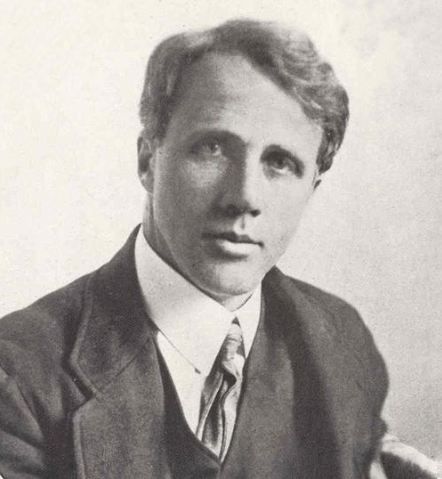
Robert Frost’s influence on Edward Thomas was life-changing, particularly during the holiday they and their families spent together in Gloucestershire in August 1914, meeting up on the very day war was declared. This is how Thomas’s wife Helen remembered it:
“Between him and Edward a most wonderful friendship grew up. He believed in Edward and loved him, understanding, as no other man had ever understood, his strange complex temperament. The influence of this man on Edward’s intellectual life was profound, and to it alone of outside influences is to be attributed that final and fullest expression of himself which Edward now found in writing poetry.”
CLIFFORD BAX MEETS EDWARD THOMAS
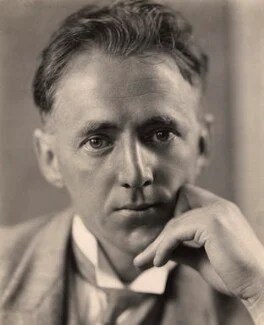
Clifford Bax (1886-1962) was born rich. Brought up in Hampstead, as a young man he kept a flat in the Albany in Piccadilly and, after marrying, bought a manor house in Wiltshire. He was an author, occultist and quite a successful playwright. His brother was the famous composer, Arnold. Clifford came across Edward Thomas in 1911. “He was then thirty-three, tall, slender, well-built, with a sad, poetic, and manly face. He spoke quietly and with deliberation. His loose-fitting clothes and strong boots at once suggested a follower of Jefferies and a friend of W H Hudson. Even at this first meeting I realized that his literary sensibility was much more finely tempered than my own, and he was good enough to point out, in the gentlest way, certain crudities in my first book – some paraphrases of Chinese poetry.”
Richard Jefferies
Themes developed in Monograph #2, MEASURING THE INFINITE. Exploring Jefferies’ unusual childhood and the revelations that changed him firstly into a prolific writer about nature and landscape, and subsequently into the prophet of a radical, godless nature religion.
JEFFERIES THE EARLY YEARS
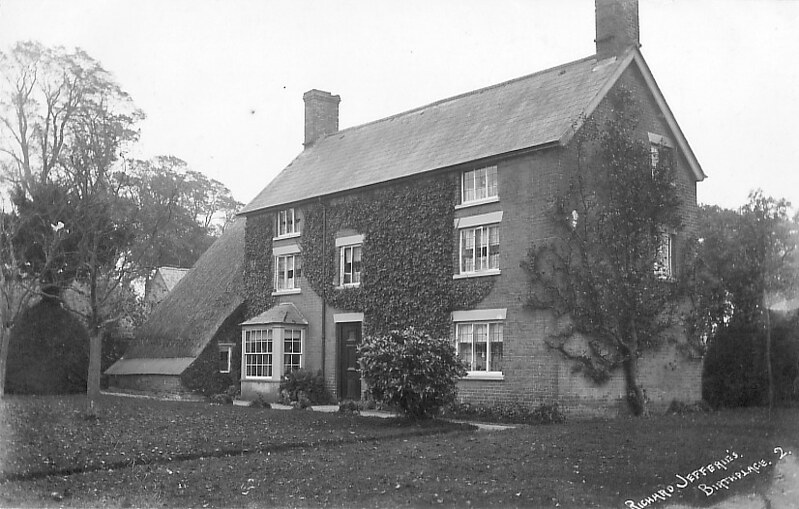
Richard Jefferies was born at Coates, a hamlet outside Swindon, in November 1848. His father was a printer-turned-gentleman farmer. When his sister died in an accident, Richard was sent to live with his aunt (also married to a printer) in South London. He was ten when he returned to Coates and thus never really found his place in rural society. As a young man he was considered odd, lazy and unmotivated. Then, when he was eighteen, he was out wandering on a hill near his home – and underwent a revelation that changed everything for him.
edward THOMAS VISITS JEFFERIES’ BIRTHPLACE
In his nature diary, included in A Woodland Walk, Thomas recorded his visit to Jefferies’ birthplace at Coate on June 1 1896:
“Opposite the old house of Richard Jefferies, on the Coate road just beyond the stile which leads a path aside to the reservoir, I met an old dame who had lived there in the old low house since a time considerably before the birth of Jefferies. She talked willingly of Jefferies; of his wanderings at all hours and on every side: and of the fact that she, in younger days, prepared the single-windowed cheese-room at Coate Farm for use as his study. The family has left the village: Jefferies himself visited it little after his marriage.”
RICHARD JEFFERIES, AGED 16, WRITES TO HIS AUNT IN LONDON
Jefferies spent much of his formative years in London, being brought up by his Aunt Ellen, wife of the successful printer Thomas Harrild. Returning to his birthplace (Coate near Swindon) when he was around ten years of age was traumatic. He did not fit in with his peers and his parents were less affectionate to him than his childless aunt and uncle.
Thomas Harrild died relatively young. Ellen remained in the marital home at Sydenham, where Richard Jefferies lodged many times. Aunt Ellen was his rock throughout his entire life (she outlived him by more than twenty years). His letters to her are our best evidence of his everyday inner life.
This is from late October 1864:
“There is nothing particular at present going forward at Coate saving time who goes as slow here as abroad. The weather (universal topic) this morning is shocking, fancy an expanse of leaden sky and a steady downfall. It is horrible after the fine time we have had. However it is the old concomitant of Winter who now comes on with giant strides as the falling leaves & piercing blasts fully testify. He is welcome provided frost sets in – jolly red nosed frost who brings wild ducks, snipes and other delicacies.
“I still walk about with my gun stalking like a chained ghost continually over the same ground and with the same luck, viz., one rabbit a week…”
Country Writing
Developing themes explored in Monograph #3, IN PURSUIT OF COUNTRY WRITING. Tracking Edward Thomas’s bicycle ride from London to the Chilterns in April 1913, during which he visited places associated with the writers who had influenced him and the pioneers who had influenced them.
An edwardian obsession
“We have reached, perhaps, the edge of a great mystery, and we are querulous and chattering as swallows before dawn.” So wrote Edward Thomas, the prolific prose-poet of all matters country, in the middle years of the first decade of the twentieth century. The mystery he refers to? Somewhat anticlimactically, it turns out to be the fact that, apparently, “No class of books is now exempt from announcements of our affection for the country.”
Thomas was almost certainly right. The late Victorians and Edwardians and even the Georgians yet to come were obsessed with the countryside. More to the point, they had a boundless appetite for reading about it, to the extent that most periodicals featured a nature column and collections of them were reviewed in the leading critical reviews. Thomas himself had been writing nature journalism for the Globe, the Speaker and the New Age since he was sixteen and his first collection, The Woodland Life, had been published by Blackwood’s when he was only nineteen.

the expedition by bicycle 1913
Edward Thomas published In Pursuit of Spring, the narrative of his bicycle journey from London to the Quantock Hills, in April 1914, a year after the excursion itself. He was thirty-six years old and had published twenty-six books – twenty-five of non-fiction prose and one novel – not counting innumerable contributions to other people’s books and hundreds of reviews and articles. Although Thomas is today known primarily as a poet, in April 1914, approaching middle age, he had not written a single poem. He was, however, a leading critic of poetry and a successful writer on nature and country matters. In Pursuit of Spring would be among his last contributions to nature prose. There would be other prose works but from December 1914 when he wrote his first poem, poetry would be his primary literary output, ending with his death at the Battle of Arras on Easter Monday, April 9 1917.

